Real Tennis and Lawn Tennis: How Two Names Took Different Paths
Real tennis and lawn tennis have related roots but distinct names and histories; learn what each term means and how to choose a match to watch.
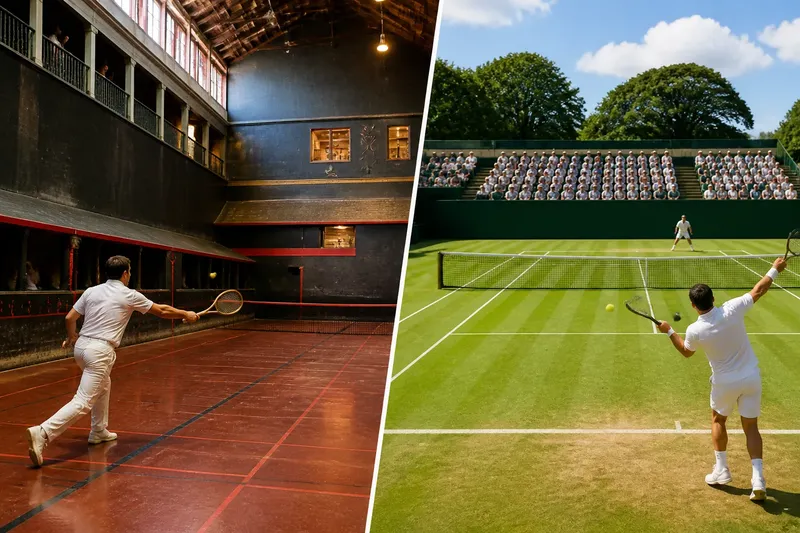
At a club, one sign may point toward an enclosed court with galleries, while a nearby lawn tennis court is open to the sky. The names real tennis and lawn tennis can sound like rival claims to the same sport, but their histories explain the difference: they identify related games that developed along separate paths.
Real tennis and lawn tennis history is also a story about naming. The word “real” does not mean authentic, and “lawn” does not require grass today. Each name stuck to a distinct form of play, with its own court, customs, and vocabulary.
Real tennis kept the name of an older court game
Real tennis belongs to an old European tradition of enclosed-court games, including forms associated with the French jeu de paume. In English, “real” developed as the customary name for this particular game; it is not a judgment that other kinds of tennis are less genuine. The game is also called court tennis in some places.
Its court makes the distinction visible. Galleries, openings, sloping roofs, and walls shape play, and the exact arrangement varies from court to court. A ball can interact with those features, so players must read the room as well as their opponent.
The name therefore carries more than a label for an old sport. It points to a specialized playing tradition in which architecture and inherited court customs remain part of the game.
Lawn tennis gained a name from its early setting
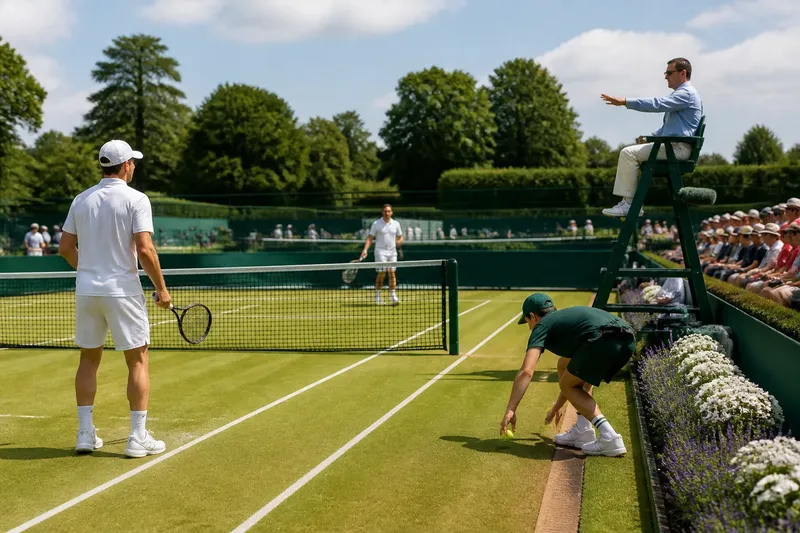
Lawn tennis took shape as a distinct outdoor game in the nineteenth century. The word “lawn” reflects its association with play on grass, while the game’s open court, net, and marked lines set it apart from enclosed-court tennis. As the game spread, it was played on other surfaces too; the historical name remained.
That history explains why “lawn tennis” can be confusing on a clay or hard court. The word describes the game’s naming heritage, not a rule that every match must take place on grass. The open layout and rules identify lawn tennis regardless of surface.
Its name also helped distinguish this outdoor form from the established enclosed-court game. Over time, people often shortened “lawn tennis” to “tennis,” especially when the context made the intended game clear.
The names describe different histories, not a simple rename
It is easy to imagine that real tennis was merely moved outdoors and renamed lawn tennis. That account leaves out the development of a separate game. Lawn tennis drew on older racket traditions, then formed around an open court and its own rules; real tennis continued as a specialized enclosed-court tradition.
Shared ancestry explains why the games have recognizable connections, including racket play and related scoring vocabulary. It does not make their courts or tactics interchangeable. “Real” names a particular game, while “lawn” recalls the setting associated with another branch of tennis.
When you see either name, ask what kind of court it refers to before assuming what the match will look like.
Choose a match or visit by what you want to notice
A court tour, a match video, and a live match each offer a different way to understand the names. Use the concrete clues below to choose a starting point.
- Check for galleries, openings, and sloping roof features. If the court has these enclosed-court features, choose real tennis material and watch where the ball can travel; if it has an open rectangle and a net, look for lawn tennis instead.
- Check whether the ball can rebound from the court’s walls. If walls affect the rally, follow a real tennis match and track the rebound; if walls sit outside the playing area, follow the open-court exchanges of lawn tennis.
- Check the court surface without treating it as the sport’s name. If you see grass, clay, or a hard court with a net and open boundaries, identify the game by its layout and rules rather than the surface; if you see an enclosed court with active walls, consider real tennis.
- Check what viewing material is available. If a real tennis court tour includes a labeled diagram, use it to match galleries and openings to the footage; if no tour is available, choose a lawn tennis match with a visible court layout and trace the lines.
- Check whether you want architecture or open-court movement to guide your viewing. If the unusual court structure interests you, select real tennis and note how features shape routes; if you want to follow serves, sidelines, and net play, select lawn tennis.
- Check for a local club or public match listing before planning a visit. If a real tennis venue offers a tour or event, confirm its visitor arrangements before going; if none is listed, look for a lawn tennis match or court that is open to visitors.
Say you have an afternoon, access to a real tennis court tour with a labeled diagram, and a lawn tennis match video. First, use the diagram to identify the galleries and openings, then watch a real tennis rally and note when the ball uses one of them. Next, watch the lawn tennis video and trace the ball between the net and court lines. You end with two clear observations: the enclosed court’s features can alter a route, while the open court organizes play around the net and boundaries. If the tour is unavailable, the tradeoff is straightforward: begin with the match video, learn the open-court layout, and save the architectural comparison for another visit.
What do the names mean in common questions?
Is real tennis the same as court tennis?
“Court tennis” is a name for real tennis in some English-speaking settings. It refers to the enclosed-court game, not to lawn tennis played on any kind of court.
Does lawn tennis have to be played on grass?
No. The name reflects the game’s association with lawn play, but lawn tennis is played on grass, clay, and hard courts. The open layout and rules identify the game, not the surface alone.
Why is it called real tennis?
“Real tennis” is the established name of a particular enclosed-court game. “Real” does not mean that other forms of tennis are inauthentic.
Which game came first?
The enclosed-court tradition behind real tennis predates lawn tennis as a codified modern game. Lawn tennis developed as a distinct form rather than as a simple outdoor renaming of real tennis.
Let the court clarify the name
When a tennis history book or club notice uses one of these names, look for the court it describes. Galleries and active walls point toward real tennis; a net across an open, marked court points toward lawn tennis. That visual distinction makes the naming history easier to follow.
For real tennis and lawn tennis history, keep the two names connected but distinct: one preserves the identity of an enclosed-court tradition, while the other recalls an outdoor game whose name outlasted its original association with grass.