A Tennis Club Noticeboard, Read as a Map of Community
A tennis club noticeboard can help you find a comfortable first event, understand club routines, and know what to confirm before you show up.
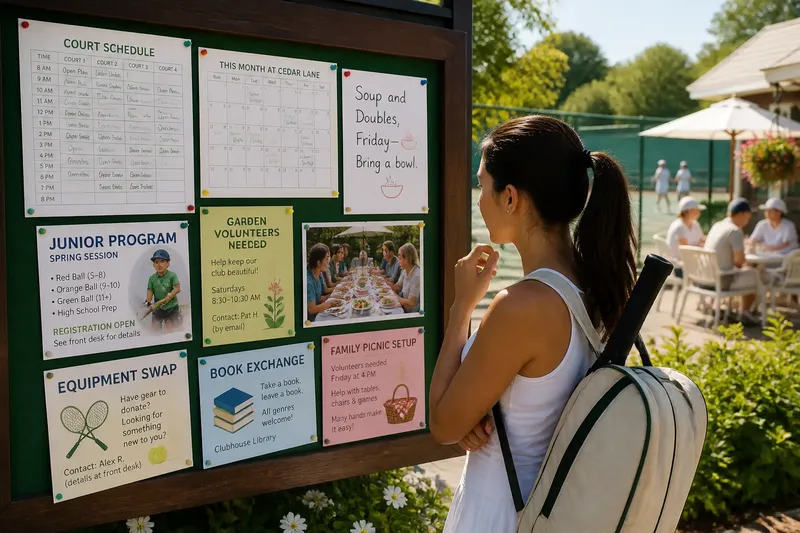
After Tuesday practice, you stop by the court schedule and spot a handwritten card: “Soup and doubles, Friday—bring a bowl.” A tennis club noticeboard can point you toward the people and routines around the courts, as well as the next event. The useful part is not decoding every flyer; it is finding one clear invitation and deciding what to ask before you go.
Imagine Maya, a new member at the fictional Cedar Lane club, sees that same card. She recognizes few faces and does not know whether the meal is open to guests or follows a members-only match. Instead of guessing, she scans for the event’s basic details, chooses a lower-pressure option, and contacts its organizer when something remains unclear.
Sort notices into routines, events, and requests
At Cedar Lane, a court-use sheet sits beside a printed calendar. Nearby are a junior-program flyer, a request for garden volunteers, a photo from a potluck, and a card for an equipment swap. Sorting these notices makes it easier to see what each one asks of a reader.
- Recurring routines: Look for repeated open play, coffee after morning tennis, or standing volunteer shifts. If a notice names its audience and time, decide whether to contact the organizer or attend; if it does not, ask before treating it as open.
- One-time events: Check for a date, location, and signup details on a meal, mixer, or cleanup notice. If those details are current and participation is clear, decide whether to go; if not, contact the listed person before making plans.
- Practical exchanges: Read what a request specifies, such as donated racquets, rides, or help setting up chairs. If your contribution matches the request, decide whether to offer it; if the instructions are vague, ask what is useful instead of bringing something unrequested.
- Group-specific notices: Check whether a flyer names a team, level, age group, or membership category. If you fit that description, decide whether to follow its signup method; if you do not, ask whether there is a related activity open to you.
- Contact details: Check whether a named organizer or club office is included. If there is a current contact, decide whether to send a short question; if there is none, ask the front desk which channel handles the event.
- Date and status: Check whether the event date has passed or the notice appears undated. If the date is current, decide whether to pursue the invitation; if it is old or missing, confirm that the event is still happening before you show up.
This quick sort is more useful than treating every sheet as equally relevant. A recurring coffee gathering may be an easy first visit, while a request for help can offer a specific way to contribute. A notice is a starting point; its details determine the next action.
Use repeated gatherings to find an easy first visit
Repeated events can help you recognize organizers and fellow members without requiring you to commit to a team. Maya sees “coffee by the patio after morning play” on several calendars. Another notice asks members to take turns bringing fruit to junior practice. These routines suggest when people may be around, but the wording still matters: some activities are for a named group, while others welcome the wider membership.
Look for direct phrases such as “new members welcome,” “all levels,” or “members and guests.” Also check whether the notice asks you to bring a partner, sign up, or attend a particular session first. A friendly tone is not a substitute for clear access details.
Say Maya finds a card reading, “Thursday coffee, clubhouse patio, after the morning group—new members welcome.” She plans to attend the coffee without joining the tennis session, then asks the organizer how the group works and whether beginners can play another time. The result is a straightforward decision: she can try the social gathering first and decide later whether the playing session suits her.
Choose the gathering whose welcome and format are stated plainly.
See how club life extends beyond matches
Not every useful notice is about playing. Cedar Lane’s board also lists a book exchange, a family picnic setup, and a school fundraiser in the clubhouse. Those activities give members reasons to meet outside a match and may include people who do not share a court.
Small, specific requests can be comfortable ways to join in. If a volunteer notice asks for help arranging chairs, you can offer that task rather than trying to infer what the club expects. If an equipment-swap card requests labeled donations, ask how to prepare an item before bringing it. The request, not an imagined obligation, should guide your contribution.
Maya has a spare junior racquet at home and sees the swap notice. Because it does not say whether used equipment is accepted, she messages the named volunteer and asks about condition and labeling. Once she gets an answer, she can decide whether the racquet fits the request or whether another contribution would be more useful.
What should you confirm before attending?
Which notices suit a new member?
Look for a clear audience, a named contact, and a specific time and place. If those details point to an open social event or volunteer task, decide whether it feels comfortable; if the notice is aimed at a group you do not belong to, ask about an alternative.
How can you tell if an event welcomes beginners?
Look for direct wording such as “all levels” or “new members welcome.” If the notice does not say, ask the organizer what participation involves and decide after you have that answer.
What if the notice is old or incomplete?
Check the date and any contact information, then ask the organizer or club staff whether the event is still happening. If they confirm it and provide the missing details, decide whether to attend; if they cannot confirm it, choose a current notice instead.
Does the board show every way members gather?
No; it shows only the notices posted there. If you want a fuller sense of club life, ask staff or members about other channels, such as club email, an app, or informal gatherings after play.
Choose one notice and make a clear plan
Imagine Maya has three options: Friday’s soup meal, the equipment swap, and the recurring coffee gathering. The meal follows doubles, and its card does not say whether people may attend without playing. The swap may suit her spare racquet, but she needs the organizer’s guidance. The coffee notice explicitly welcomes new members and gives a time and place.
She sends the coffee organizer a short message: she is new, wants to stop by, and asks where the group meets. The reply confirms the patio and says she can come whether or not she plays. Maya writes down the event and location, attends, and asks how players join the open session. She leaves with a contact for the next question rather than a guess about club customs.
For your own visit, use the notice’s details to make one decision at a time:
- Check the date; if it is current, decide whether to follow up, and if it has passed, look for a newer listing.
- Check the stated audience; if it includes you, consider attending, and if it names another group, ask about a suitable alternative.
- Check the time and place; if both are clear, plan your arrival, and if either is missing, ask the organizer before going.
- Check for signup or partner requirements; if you can meet them, follow the instructions, and if you cannot, ask whether another format is available.
- Check what to bring; if the notice names an item, bring that item, and if it says nothing, ask before bringing food or equipment.
- After the event, notice whether you felt comfortable; if you would return, keep the organizer’s contact, and if not, try a different kind of gathering.
A first visit is information, not a verdict on the whole club. A social event may suit you better than a competitive session, or a volunteer task may feel easier than joining a doubles group. Let the experience shape your next choice without treating it as a test you have to pass.
Read the noticeboard as a prompt for conversation
A tennis club noticeboard can help you spot recurring activities, open invitations, and people to contact. It cannot tell you everything about the club, and you do not need it to. Find a notice with a clear next action, confirm any detail that affects your plans, and use the visit to learn what the board cannot show.
Keep the main search phrase, tennis club noticeboard, in mind as a practical starting point rather than a puzzle. One specific question to an organizer can settle whether an event is current, who may attend, or what to bring—and make your next step easier to choose.